

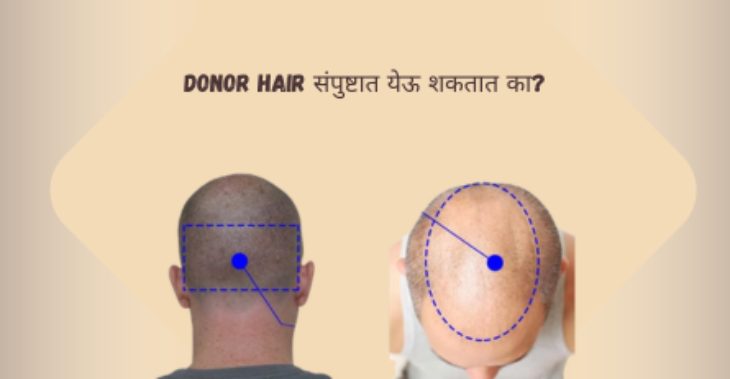
Donor Hair संपुष्टात येऊ शकतात का? Can Donor Hair Get Exhausted?
One of the most common questions people ask while considering a hair transplant is whether the hair at the back and sides of the scalp can eventually run out.
The concern is understandable. A hair transplant uses hair follicles taken from a donor area and moves them to areas affected by thinning or baldness. Since the donor area has a limited supply of hair, patients naturally want to understand how much can be used and what happens if they need another procedure in the future.
Can donor hair get exhausted? Yes, the usable donor supply is limited, and excessive harvesting can reduce the density of the donor area. However, this does not mean that every person who undergoes a hair transplant will exhaust their donor supply. The outcome depends on the natural density of the donor area, hair characteristics, the extent of hair loss, the number of grafts removed and how carefully the procedure is planned.
Understanding donor hair availability is important before making a decision about hair restoration. A transplant should not be planned only around the number of grafts someone wants in the first session. The assessment should also consider the likely progression of hair loss and the amount of donor hair that may be needed in the future.
This article explains how donor hair works, why its supply is limited, what can happen after multiple procedures and which factors should be considered when planning a hair transplant.
What Is Donor Hair in a Hair Transplant?
Donor hair refers to hair follicles taken from one area of the body and transplanted into another area where additional hair coverage is needed.
In a conventional scalp hair transplant, follicles are commonly taken from the back and sides of the head. These areas are often called the donor zone.
Hair from this region is frequently used because follicles in the relatively stable donor area tend to be less affected by the processes responsible for common pattern hair loss. However, this characteristic varies between individuals, and not every follicle in the back or sides is necessarily suitable for transplantation.
A donor assessment considers more than the number of visible hairs. It may include:
- Hair density per unit of scalp area
- Hair thickness and texture
- The number of hairs contained in each follicular unit
- The size and stability of the donor zone
- Existing thinning or miniaturisation
- Scalp condition and previous procedures
- The likely progression of hair loss
These factors help determine whether enough suitable donor hair is available for a planned procedure.
Can Donor Hair Really Get Exhausted?
The donor area has a finite supply of suitable follicles. Once follicles have been removed from a particular area, they are not naturally replaced in the same location in a way that restores the original donor density.
This is why donor hair needs to be treated as a limited resource.
The term donor exhaustion is generally used when repeated or excessive harvesting leaves too little suitable hair for further transplantation, or when the donor area becomes visibly thin or uneven.
There is an important distinction between using some donor hair and exhausting the donor supply.
A carefully planned procedure may remove an appropriate number of grafts while preserving an acceptable appearance in the donor area. In contrast, removing too many grafts from a limited area can make the scalp look sparse, patchy or uneven.
The risk is influenced by the person’s starting density, scalp characteristics, extraction pattern and total number of grafts removed across all procedures.
Therefore, the number of grafts that can be safely harvested should be determined individually rather than estimated from a standard number advertised for everyone.
Why Is Donor Hair Limited?
The scalp does not contain an unlimited number of transplantable follicles.
A person may have a large number of hairs, but only a portion may be suitable for harvesting. Some follicles are located outside the stable donor zone, while others may be too fine, miniaturised or otherwise unsuitable for the intended procedure.
The amount of usable donor hair depends on several factors.
1. Natural hair density
People naturally differ in the number of follicles present in a given area of scalp.
A person with a dense donor area may have more potential donor hair than someone whose hair is naturally fine or sparse. However, density alone does not determine the final graft allowance.
2. Hair thickness
Thicker hair shafts may provide more visual coverage than finer hair, even when the number of grafts is similar.
This is one reason why graft counts alone cannot predict the appearance of the final result.
3. Follicular unit composition
A follicular unit may contain one, two, three or sometimes more hair follicles.
The number of grafts and the total number of individual hairs are therefore not the same measurement. A plan should consider both the available follicular units and the characteristics of the hair they contain.
4. Size of the stable donor area
The donor zone varies between individuals. If the area that can be harvested safely is relatively small, the available supply may also be limited.
5. Existing donor thinning
If the back or sides of the scalp already show thinning, the usable donor supply may be reduced. Additional evaluation may be needed to determine whether transplantation is appropriate.
How Many Grafts Can Be Taken From the Donor Area?
There is no single graft number that is safe or appropriate for everyone.
The amount that can be harvested depends on donor density, the size of the suitable area, hair characteristics, the harvesting technique, previous procedures and the patient’s long-term hair restoration needs.
A person with a strong donor area may have a different harvesting capacity from someone with finer hair or early thinning in the donor region.
It is also important to distinguish between the number of grafts that can technically be removed and the number that can be removed while maintaining an acceptable donor appearance.
The second consideration is essential.
Removing a large number of grafts in one session may not be appropriate if it creates excessive depletion, compromises the donor area or leaves too little reserve for future needs.
A responsible assessment should explain the estimated donor capacity, the intended harvesting area, the limitations of the procedure and the uncertainty involved in predicting future hair loss.
Does FUE Hair Transplant Exhaust the Donor Area?
Follicular Unit Extraction, commonly known as FUE, involves removing individual follicular units from the donor area.
Because follicles are extracted individually, FUE does not leave the same linear scar associated with the conventional strip-harvesting method. However, it still involves removing follicles from the scalp.
FUE does not create an unlimited donor supply.
If too many grafts are removed, the donor area can become visibly depleted. Uneven extraction may also create a patchy appearance, especially if the hair is worn very short.
The risk depends on how much hair is removed, where the extractions are performed and the characteristics of the donor area.
For this reason, FUE planning should include an assessment of extraction distribution and the density that will remain after harvesting.
Can FUT Also Lead to Donor Hair Depletion?
Follicular Unit Transplantation, or FUT, involves removing a strip of scalp from the donor region and separating it into follicular units for transplantation.
This method generally leaves a linear scar. The amount of hair available for a future procedure depends on the donor area’s characteristics, the previous surgery and the way the scalp has healed.
FUT does not remove the limitation on donor supply. The available hair and scalp flexibility remain finite.
A previous FUT procedure may also influence the planning of later surgery because the donor area has already undergone tissue removal and healing.
The suitability of FUT, FUE or another approach depends on individual clinical factors. Neither method should be assumed to provide unlimited grafts or to be appropriate for every patient.
What Happens If Too Many Donor Grafts Are Removed?
Excessive harvesting can affect both the appearance and the future usability of the donor area.
Possible consequences include:
- Reduced hair density at the back or sides of the scalp
- Visible gaps or an uneven appearance
- Small scars becoming more noticeable
- Reduced flexibility in hairstyle choices
- Less donor hair available for future procedures
- Difficulty achieving a balanced appearance between donor and recipient areas
The severity depends on the amount and distribution of harvesting, the healing process and the individual’s scalp and hair characteristics.
Donor depletion can be particularly noticeable in people who prefer very short hairstyles because less hair remains to conceal the extraction sites.
This is why the donor area should be considered part of the overall aesthetic plan, not simply a source from which as many grafts as possible should be taken.
Can You Undergo a Second Hair Transplant If Donor Hair Is Limited?
A second hair transplant may be possible, but it depends on how much suitable donor hair remains and whether another procedure is clinically appropriate.
The assessment should include the previous harvesting pattern, current donor density, the condition of the scalp and the amount of hair loss that still needs to be addressed.
A second procedure should not automatically be planned because the first transplant has healed.
Hair loss can continue in untreated areas after transplantation. If a large amount of donor hair is used early without considering future progression, there may be limited flexibility later.
For this reason, the long-term plan should consider the patient’s current needs as well as the possibility of further thinning over time.
If the remaining donor supply is insufficient, the appropriate option may be to reassess the treatment goals rather than attempt to obtain more grafts from an unsuitable area.
Can Donor Hair Grow Back After Extraction?
Follicles that have been completely removed from a donor site do not simply grow back in their original positions.
However, the donor area still contains follicles that were not extracted. These remaining follicles continue to produce hair according to their own growth cycles and characteristics.
The appearance of the area after harvesting depends on how much hair remains, how evenly it is distributed and how the scalp heals.
Some people may notice that the donor area looks less dense after a procedure. This is not necessarily evidence of a complication, but significant thinning, patchiness or persistent discomfort should be assessed by the treating clinician.
It is important to have realistic expectations: the donor area is not restored to its original follicle count simply by waiting for the removed follicles to return.
Can Body Hair Be Used if Scalp Donor Hair Is Insufficient?
In selected cases, hair from other parts of the body may be considered as an additional donor source. Beard hair is one possible option, while hair from other body regions may be evaluated in specific circumstances.
However, body hair differs from scalp hair in thickness, length, growth cycle, texture and other characteristics.
It may not behave or look the same when transplanted into the scalp. Its suitability also depends on the recipient area’s requirements and the patient’s individual characteristics.
Body hair transplantation is not a universal substitute for scalp donor hair. It requires careful assessment, and the expected contribution to coverage can vary.
When the scalp donor supply is limited, the available options should be discussed realistically. The objective is to understand what may be suitable, rather than assuming that additional donor sources will always provide enough hair to achieve a particular level of coverage.
Why Future Hair Loss Must Be Considered Before a Transplant
Hair transplantation redistributes existing follicles. It does not prevent every other hair on the scalp from thinning in the future.
This distinction matters because the appearance of the recipient area may change as surrounding, non-transplanted hair continues to thin.
For example, a hairline designed without sufficient consideration of future hair loss may create an imbalance later. The donor area may also have been used more heavily than necessary to achieve an immediate cosmetic goal.
Long-term planning should therefore consider:
- The current pattern of hair loss
- Whether the hair loss appears stable or progressive
- The person’s age and family history
- The characteristics of the donor zone
- The intended coverage and hairline design
- The possibility of future thinning
- The amount of donor hair that should remain unused
No assessment can predict every future change with complete certainty. Nevertheless, considering these factors can help make the planning process more informed.
How to Protect Your Donor Area Before and After a Hair Transplant
Donor preservation begins with appropriate planning rather than with a particular shampoo, oil or supplement.
Before surgery, the donor area should be assessed to understand its density, suitability and likely long-term capacity.
Patients should also share information about previous procedures, medical conditions, medications and any history of thinning in the donor region.
After the procedure, follow the treating clinician’s instructions for scalp care and recovery. Avoid rubbing, scratching or applying unapproved products to healing areas.
A general overview of hair transplant care can help readers understand why post-procedure instructions matter, although the exact care routine should depend on the procedure performed and the clinician’s advice.
Healthy nutrition and general scalp care support overall hair health, but they cannot replace follicles removed during harvesting or guarantee that the donor area will regain its original density.
Is Hair Loss After a Transplant Always Donor Exhaustion?
No. Hair shedding after a transplant or during another period of life does not automatically mean the donor supply has been exhausted.
Hair can shed for different reasons, including temporary changes in the hair-growth cycle, illness, physical stress, nutritional problems, medication-related effects and scalp conditions.
The timing and pattern of shedding are important. If you experience Sudden Hair Shedding, the cause should be assessed rather than assuming that donor depletion is responsible.
Donor exhaustion refers to a limitation in the remaining suitable donor supply, usually associated with previous harvesting or the characteristics of the donor zone. It is different from general shedding across the scalp.
If thinning develops in the donor area, a clinical examination can help determine whether it is related to harvesting, an underlying hair condition or another cause.
When Should You Seek a Donor Area Assessment?
A professional assessment is appropriate if you are considering a hair transplant, planning another procedure or noticing changes in an area where grafts were previously harvested.
Consider seeking an evaluation if you notice:
- Visible thinning at the back or sides of the scalp
- Patchiness after a previous transplant
- Persistent redness, pain or unusual swelling during recovery
- Changes in the donor area’s appearance
- Progressive thinning outside the transplanted region
- Uncertainty about how many grafts may remain available
If you are reviewing information about a Hair transplant Surgeon in Mumbai, focus on whether the information clearly explains the assessment process, donor limitations, possible risks and the need for individual planning. Professional qualifications and registration details should be factual and verifiable.
A donor assessment should explain the limitations as well as the possible options. It should not rely on a fixed graft promise or imply that every person is suitable for transplantation.
What Should You Understand Before Deciding on a Hair Transplant?
Before making a decision, make sure you understand the purpose of the proposed procedure and how it fits into your longer-term hair restoration plan.
Useful questions include:
- How much suitable donor hair is available?
- How is the proposed graft number being determined?
- What density is expected to remain in the donor area?
- Could future hair loss affect the overall appearance?
- What are the limitations of the selected harvesting method?
- What alternatives are available if donor hair is insufficient?
- What risks and recovery requirements should be understood?
The answers should be based on your individual assessment, not on general promises made to all patients.
The decision to proceed should be made after understanding the expected benefits, limitations, possible complications and alternatives. There is no need to assume that a larger graft number is always the better option.
So, can donor hair get exhausted?
Yes, the supply of suitable donor hair is limited, and excessive harvesting can deplete the donor area. However, the extent of this risk differs from person to person.
Natural donor density, hair thickness, the size of the stable donor zone, previous procedures and the likely progression of hair loss all influence how much hair may be suitable for transplantation.
FUE and FUT use different harvesting methods, but neither removes the natural limit on donor supply. Body hair may be considered in selected circumstances, although it has different characteristics and cannot be assumed to replace scalp donor hair completely.
The most important principle is to plan for the long term. A transplant assessment should consider the recipient area, the donor area and the possibility of future hair loss together.
A well-informed decision starts with understanding what the available donor hair can reasonably support, what limitations remain and which options are appropriate for the individual.
FAQ
1. Does donor hair get exhausted after a hair transplant?
The available donor supply can become depleted if too many grafts are removed or if the donor area has limited natural density. Appropriate planning aims to preserve the remaining hair and maintain an acceptable donor appearance.
2. Can donor hair grow back after FUE?
Follicles that have been completely extracted do not grow back in their original positions. Hair continues to grow from the follicles that remain in the donor area, and the final appearance depends on the remaining density, extraction pattern and healing.
3. Can I have another hair transplant if my donor area is thin?
A further procedure may be possible in some cases, but it depends on the remaining suitable donor hair, previous harvesting and the cause of thinning. A clinical assessment is needed to determine whether another procedure or an alternative approach is appropriate.